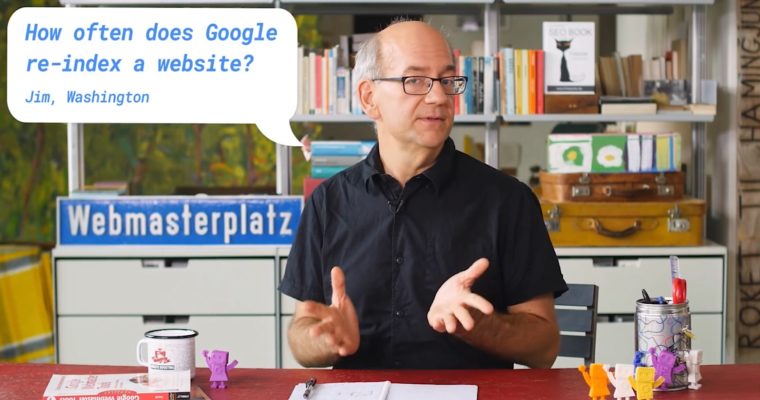
How long Google takes to index a website is not a fixed number. On small, well-linked sites, a new URL can enter the index in hours or a couple of days. On large, poorly linked or low-history sites, the same URL can wait weeks. Reindexing a change (a title, a body of text, a product) follows a different logic: Googlebot has to come back, and it does not crawl the whole site every night.
John Mueller has repeated this in Google’s Q&A sessions: crawling a domain all at once is counterproductive. Daily crawling is capped by server capacity and by what Google treats as a priority. That is why the homepage and top-level categories update before an old blog post.

Crawl, indexing and ranking
These are three different steps, and they get mixed up in almost every Search Console thread.
Crawling is Googlebot’s visit. Crawl budget is how many URLs Google is willing to request in a given period. That is the same problem whether you search for crawl budget or for how often Google recrawls.
Indexing is the decision to store that URL in the index. Google can crawl a page and still not index it (thin content, duplicates, noindex, a canonical pointing elsewhere).
Ranking comes later. Being indexed does not mean ranking. A page can sit in the index and still fail to appear for any useful query.
If technical SEO is broken (robots.txt, noindex, blocked JavaScript, redirect chains), the indexing clock does not even start.
How often Google reindexes a site
Google does not reindex “the site”. It reindexes URLs, on different schedules.
Pages high in the architecture (home, categories, product templates that already get traffic) are crawled more often because they change more and because they concentrate internal links. A 2019 post that no longer gets visits may wait months for a recrawl, or stop being recrawled on a regular basis.
That has an editorial consequence. If you update the homepage, the change shows up in results sooner. If you rewrite a deep article without linking it from URLs Googlebot already visits, the recrawl is delayed. On sites with thousands of URLs, crawl budget is wasted on parameters, facets and pagination if those are not controlled. Every useless URL Googlebot requests is a useful URL that waits.
Mueller’s point is not to force a mass crawl “so Google sees everything”. The server suffers and Googlebot pulls back. Better that important URLs are linked, that the sitemap is accurate, and that URLs that should not be indexed are kept out of the index on purpose.
How long Google takes to index a new page
Real ranges, not promises:
A brand-new site, with no links and no history, can take days or weeks to be seen for the first time. The first crawl sometimes arrives within 24–72 hours if a sitemap is submitted and the property is verified in Search Console.
A new URL on a domain Google already crawls is usually faster: hours or a few days, especially with an internal link from a page Googlebot already visits.
A content update on a URL that is already indexed can take from a few hours (if you request indexing and still have quota) to several weeks (if you wait for a natural recrawl).
Nobody at Google publishes an SLA. Search Console threads and Mueller’s answers line up: be patient, and put priority on the URLs that matter.
How to request indexing in Search Console
The old path (“Fetch as Google”, under Crawl) is gone. The flow today is this:
Verify the property in Google Search Console.
Open URL Inspection, paste the absolute address (with https) and wait for the diagnosis.
If the URL is crawlable and indexable, use “Request indexing”. There is a daily quota per property. It will not empty a whole inventory.
That does not guarantee a position or a date. It is a priority hint. Googlebot may respond in hours or ignore the request if the URL is blocked, redirects, is a duplicate, or the site has already exhausted quality signals.
Other levers that do speed up recrawl, without burning the quota:
An updated sitemap, with a coherent lastmod and only indexable canonical URLs.
Internal links from live pages (menu, hub, related articles), not only from the footer.
Indexing a new article on the day you publish it, especially if the content is easy to copy. Anyone who publishes and waits “for Google to pass by” leaves the URL open to whoever syndicates first.
Pings to social and to the Indexing API (the API is meant for job postings and livestream/video pages with JobPosting or BroadcastEvent; it is not a general shortcut for blogs).
Why a URL never enters the index
Before blaming the calendar, check the Page indexing report. The usual causes are prosaic:
noindex inherited from a template or a plugin.
A canonical pointing at another URL.
robots.txt blocking the directory.
Duplicate or near-empty content.
A redirect chain or an intermittent 5xx.
An orphan page (zero internal links).
In those cases, requesting indexing fixes nothing. Googlebot will arrive, see the same obstacle and leave. That is technical SEO work, not patience.
What to expect after a change
A cosmetic change to the title or H1 of an already strong URL often shows up in days. An architecture change (moving folders, merging http/https, switching www) is measured in weeks, sometimes months, and needs clean 301 redirects.
If an old post no longer brings traffic, updating it “so Googlebot comes back” only makes sense if you will link to it again and actually improve the content. Otherwise that recrawl competes with URLs that convert.
Waiting is part of the process. What you can shorten is the queue: fewer junk URLs in the crawl budget, more internal links to what should be reindexed, and a one-off request in Search Console when the URL is new or has genuinely changed.


