
When we talk about SEO, attention often focuses on content, keywords or backlinks. However, there is one element that connects everything and, when handled well, can make a major difference in SEO rankings: internal linking.
It is not just about adding links between pages. It is about building a coherent structure that helps Google understand your website and helps users navigate logically and easily.
In this article, we explain what internal linking is, what types exist, how to apply it strategically and which common mistakes you should avoid.
What is internal linking and why is it so important in SEO?
It is the set of links that connect different pages within the same domain. In other words, when you link from a blog article to other related content on your own website, you are creating an internal link.
Unlike external linking, which points to other domains, internal linking works on the structure and distribution of authority within your own site.

Its importance lies in three key factors:
- It makes crawling easier: search engines follow links to discover new pages.
- It helps understand hierarchy: it identifies which pages are more relevant.
- It distributes internal authority: it passes SEO strength between URLs.
If a page does not receive internal links, it practically does not exist for Google. And even if it is published and optimized, it may remain outside the search engine’s radar.
How does interlinking work within a web architecture?
Internal linking does not work in isolation. It is part of the site’s architecture, that is, how the different pages are organized and connected.
Hierarchy and structure
Every website should have a logical structure:
Home
-> Categories
-> Subcategories
-> Content or listings
The clearer that hierarchy is, the easier it will be for Google to understand the context of each page.
Authority distribution
Each page passes part of its authority through links. If a URL receives many internal links from relevant pages, its weight within the domain increases.
For example, if you have an article that generates a lot of organic traffic and you link from it to a strategic category, you will be strengthening that category at an SEO level.
Click depth
The more clicks a page needs to be reached from the home page, the lower its perceived relevance usually is.
A good practice is for strategic pages to be no more than three clicks away.
Orphan pages
An orphan page is one that does not receive any internal links. Even if it is included in the sitemap, if it has no internal links, Google will find it difficult to crawl it frequently.
This is one of the most common problems on websites that grow without planning.
Types of interlinking
Not all internal links serve the same function. Understanding their types will help you structure them better.
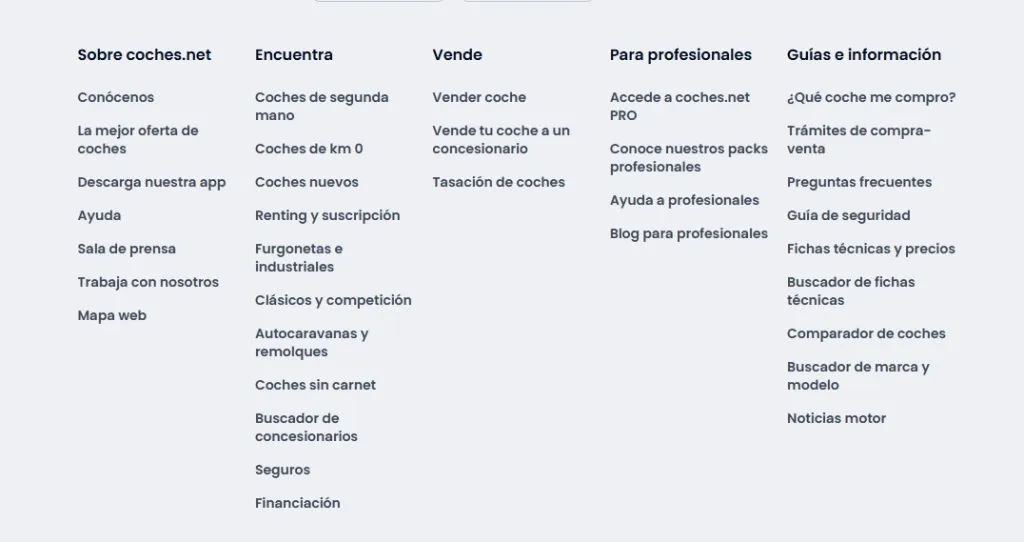
Structural links
These are links that form part of the fixed structure of the site:
- Main menu
- Footer
- Breadcrumbs
- Sidebar
These links define the base architecture and help establish the site’s main hierarchy.
For example, including a strategic category in the main menu sends Google a clear signal of importance.
Contextual links
Contextual links are those inserted within the content, naturally and coherently with the topic being discussed. They are an active part of the internal linking strategy and are usually integrated within sentences or paragraphs that are already developing a specific idea.
They are the most powerful from an SEO point of view because:
- They provide semantic context
- They reinforce the topic
- They improve the user experience
When the anchor text correctly describes the destination page, it helps Google understand the relationship between both pieces of content and strengthens the structure of the web architecture.
For example, if you are reading an article about an SEO audit and it links to another piece of content about web architecture, that link has topical coherence, fits naturally within the text and provides real value to the user.
Silo linking
Silo linking consists of grouping content by topic and mainly linking it to related content within the same group.
Imagine you have several articles about technical SEO. Instead of linking them in a scattered way across the website, you connect them strategically to one another, reinforcing that topic.
This helps Google identify that your website has authority on that specific subject.
Internal linking strategies that really work
Having internal links is not enough. You need to apply them with judgment.
- Prioritize strategic pages. Not all pages have the same goal. Some are designed to rank for important keywords, others to convert. Identify which URLs are your priorities and strengthen them with more internal links from relevant content.
- Take advantage of content with traffic. If you have articles that already rank well, use them to transfer authority to other pages you want to boost. It is a smart way to make the most of work already done.
- Optimize anchor text without forcing it. Anchor text should describe the destination content, but without falling into over-optimization. Avoid overusing the exact keyword in every link and alternate natural variations.
- Update old content. Reviewing old articles and adding links to new content is a very effective practice. In addition to improving the internal structure, you keep the content updated and coherent.
Common internal linking mistakes
Although the concept of internal linking seems simple, it is common to make mistakes that end up weakening the SEO strategy. Often it is not a matter of doing something “wrong”, but of not applying it with clear structural logic within the web architecture.
These are the most frequent issues we detect in audits:
Always linking to the home page
Many websites concentrate a large share of their links toward the home page. This happens especially in blogs or corporate websites where almost any mention ends up pointing to the home page.
The problem is that the home page is usually already the URL with the most authority on the domain. Continuing to send internal links to it does not provide any real strategic benefit and, instead, leaves internal pages that could rank for specific keywords without reinforcement. An effective interlinking strategy distributes authority toward strategic categories, services or articles, not only toward the home page.
Using generic anchors
Texts such as “click here”, “more information” or “see more” do not provide semantic context or help Google understand what the destination page is about.
Anchor text is a relevant signal within SEO. When you use descriptive texts that are coherent with the topic, you reinforce the relationship between both pages. It is not about always repeating the exact keyword, but about using natural variations that describe the linked content. This improves both search engine understanding and the user experience.
Too many links on the same page
Adding too many internal links in the same piece of content can create the opposite effect to the one desired. Instead of strengthening the structure, you dilute the authority passed by each link and make navigation more difficult. From the user’s point of view, text saturated with links feels confusing and unnatural. From an SEO point of view, spreading too much authority on a single page reduces the impact of the most important links.
The key lies in coherence and strategic intent. Every link should have a clear purpose within the web architecture.
Not reviewing broken links
Internal links that point to deleted pages or modified URLs generate 404 errors. This not only affects the user experience, but also wastes internal authority. If a page passes SEO strength to a URL that no longer exists, that value is lost. In addition, a high volume of errors can send negative signals about site maintenance.
Periodically reviewing internal links and applying redirects when necessary is a basic task in any SEO audit.
Not detecting orphan pages
An orphan page is one that does not receive any internal links from other sections of the site. Even if it is published, if it is not part of the linked structure, it is very difficult for Google to crawl it frequently or consider it relevant.
This problem usually appears on websites that grow without planning, where new content is published but not correctly integrated into the existing architecture. Detecting and correcting orphan pages is essential to ensure that all content has a real chance of ranking.
How to audit your internal linking step by step
An internal linking audit makes it possible to detect improvement opportunities.
- Analyze the structure: Review how your categories are organized and whether the hierarchy makes sense.
- Identify pages with few internal links: Detect which important URLs receive hardly any links.
- Find orphan pages: Check whether there is content that is not linked from any other section.
- Review anchors: Assess whether anchor texts are descriptive and varied.
- Prioritize improvements: Not all problems have the same impact. Start with strategic pages.
At SeDigital, we recommend carrying out this type of review periodically, especially when the website grows or new categories are added.
Benefits of a good internal linking strategy
When internal linking is well planned, the results are noticeable both in terms of rankings and overall site performance. It is not just about linking for the sake of linking, but about building a structure that strengthens the entire SEO ecosystem of the website.
Better rankings
A good internal linking strategy helps Google understand the hierarchy, topical relationship and importance of each URL within your web architecture. By correctly distributing internal authority, you make it easier for strategic pages to gain relevance and improve their SEO rankings in search results.
Greater visibility for deep pages
When you optimize internal linking, pages that are deeper within the site stop depending exclusively on the sitemap or occasional crawling. By receiving more internal links from relevant content, their chances of being crawled more frequently and attracting organic traffic increase.
Better user experience
Coherent internal linking improves navigation and makes it easier for users to find related content without effort. This increases dwell time, reduces bounce rate and creates a more natural journey through the site, factors that also indirectly influence SEO.
Better authority distribution
Instead of concentrating all strength on the home page, a well-designed strategy distributes SEO authority across categories, services and key articles. This correct authority distribution makes the whole domain work in a balanced way, maximizing the potential of each section and strengthening the overall structure.
Frequently asked questions about internal linking in SEO
How many internal links should a page have?
There is no exact number. The important thing is for every link to make sense and provide value. Quality should always come before quantity.
Is it advisable to always use the exact keyword in the anchor?
No. It is better to alternate natural variations to avoid artificial patterns.
Does internal linking influence crawl budget?
Yes. A clear structure makes crawling easier and allows Google to use its crawl budget better.
How do I know if I have orphan pages?
You can detect them with crawling tools that analyze the internal structure and compare indexed URLs with linked URLs.
How often should it be reviewed?
It depends on the website’s growth rate, but at least once per quarter or after major structural changes.


