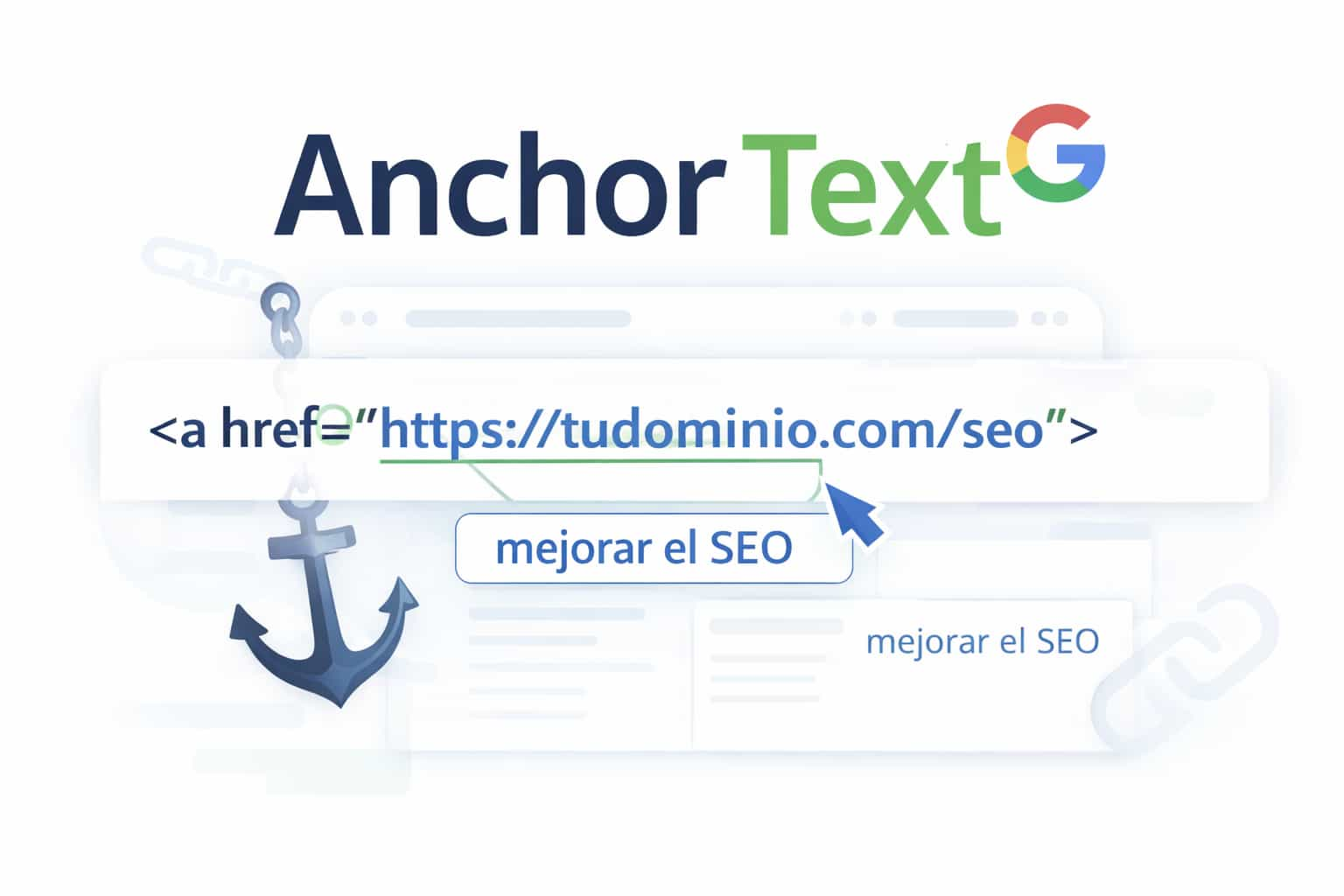
Anchor text is one of the most important factors in a linking strategy.
It has a direct impact on how Google interprets the topic of a page and how authority is distributed within a website.
Optimizing it well can improve your rankings.
Optimizing it badly can lead to over-optimization.
What is anchor text and what does it mean in SEO?
It is the part of the link that the user sees on screen and can click on.
Example in HTML:
href=“https://www.sedigital.es/en/blog/what-is-technical-seo/">what technical SEO is<
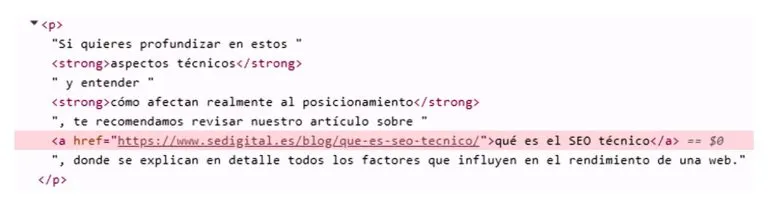
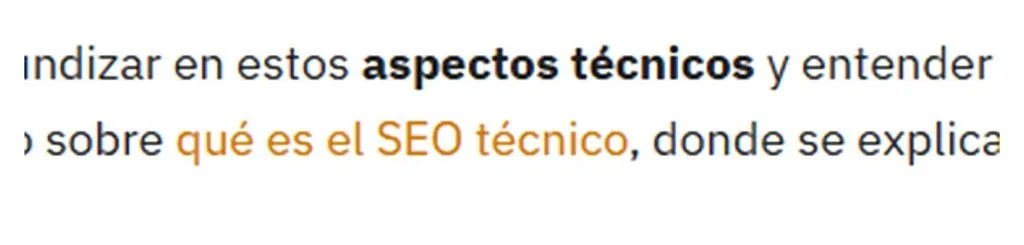
In this case, the anchor text is: what technical SEO is.
Difference between anchor text, link and URL
URL
Destination web address.
Link
Structure that connects one page to another.
Anchor text
Visible text that contains the link.
They are not the same thing, although they are often confused.
How Google interprets it
Google uses anchor text to:
- Understand the topic of the linked page.
- Detect semantic relationships.
- Evaluate contextual relevance.
- Analyze optimization patterns.
In simple terms: the anchor text tells Google what the destination page is about.
Why is anchor text so important for SEO?
Anchor text is a semantic signal.
When several pages link to a URL using terms related to a specific keyword, Google interprets that URL as relevant to that topic.
Relationship between anchor text and topical authority
A good anchor text profile helps to:
- Reinforce strategic keywords.
- Build topical authority.
- Improve rankings for specific searches.
Influence on PageRank
Every link passes authority.
But the link itself is not the only thing that matters; the context in which it is inserted and the text around it also matter.
A well-optimized anchor can reinforce the search intent of the destination page.
Types of anchor text that exist (with real examples)
1. Exact match
The anchor exactly matches the target keyword.
Example: SEO agency in Madrid
Moderate use is recommended.
2. Partial match
It includes variations or related words.
Example: professional SEO positioning services
It is more natural and advisable in most strategies.
3. Branded anchor
It uses the company or domain name.
Example: SeDigital
Very safe and natural.
4. Generic anchor
It does not provide clear semantic context.
Example: more information
It should be used in moderation.
5. URL as anchor
The web address itself acts as the anchor text.
Example: https://sedigital.es
Natural in some contexts, but it does not provide semantic optimization.
7. Non-descriptive anchor text
It does not describe the destination content.
Example: read more
It does not help reinforce topical relevance.

What is the best anchor text for a link?
There is no single “best” anchor text that works for every case.
The best anchor text is the one that helps the user understand what they will find, fits naturally within the content and, at the same time, provides semantic context to Google without falling into artificial patterns.
To choose it well, you need to consider four variables: search intent, link type, context and the overall anchor profile.
It depends on search intent
Anchor text should reflect the intent with which the user would click.
Remember that Google does not only read the keyword: it interprets the meaning of the link within a sentence and within the topic of the article.
Informational intent
If you link to educational or explanatory content, the anchor should anticipate that.
Suitable examples:
- guide to anchor text in SEO
- what anchor text is and what it is used for
- examples of anchor text
Here the goal is not to sell, but to answer questions.
Commercial / comparative intent
If you link to evaluation or comparison pages, the anchor should convey analysis or decision-making.
Examples:
- best SEO services for companies
- how much an SEO audit costs
- SEO agency specialized in ecommerce
Here the user is weighing up options.
Transactional intent
If you link to a conversion landing page, the text can be more direct, but without forcing aggressive exact match.
Balanced examples:
- hire SEO consulting
- request an SEO quote
- organic positioning service
The key is clarity, not over-optimization.
It depends on the type of link
An internal link is not optimized in the same way as an external backlink.
Internal links (full control)
Here you can be strategic because the goal is to:
- Guide the user.
- Build topical architecture.
- Push strategic pages.
- Reinforce content clusters.
Best practices for anchor text:
- Use descriptive and semantic anchors. Vary the text according to the paragraph context.
- Avoid repeating the same exact match within the same article.
- Prioritize topical coherence between pages.
Example of natural variation toward a “SEO services” URL:
- organic positioning services
- SEO consulting for companies
- improve your website’s SEO
- agency specialized in SEO
This reinforces relevance without creating an artificial pattern.
External links (backlinks)
Here the risk of over-optimization is higher because Google analyzes patterns. If it detects excessive repeated exact match across multiple domains, it may interpret it as manipulation.
Best practices for external anchor texts:
- Prioritize branded anchors.
- Include partial and semantic variations.
- Use naked URLs in some cases.
- Reserve exact match for natural and limited contexts.
Example of a healthy external profile:
- SeDigital (brand)
- sedigital.es (URL)
- SEO agency in Spain (partial)
- organic positioning specialists (semantic)
It depends on domain authority
New domain or domain with few links
- Avoid a high percentage of exact match.
- Prioritize brand and natural anchors.
- Build the profile progressively.
If your profile is small, any repetitive pattern is easier to detect.
Indicative healthy distribution
There is no universal formula, but a natural profile usually falls within these ranges:
- 40-50% brand
- 20-30% generic or neutral
- 15-25% partial or semantic
- 5-10% exact match
These percentages vary depending on the sector, competition and strategy.
The important thing is not to meet an exact number, but for the profile to:
- Look natural.
- Avoid artificial spikes.
- Avoid relying on a single type of anchor.
How to optimize anchor text strategically
The most common mistake is overusing exact-match anchors.
This can create artificial patterns and trigger algorithmic filters.
Step 1: Analyze your current profile
In tools such as:
- Ahrefs
- SEMrush
- Google Search Console (external links)
Review:
- % exact match
- % brand
- Suspicious anchors
- Irrelevant anchors
Step 2: Align anchors with search intent
Example:
Target keyword: SEO agency
Correct anchors could be:
- agency specialized in SEO
- organic positioning experts
- professional SEO consulting
Not everything should be “SEO agency”.
Step 3: Optimize internal linking before external linking
You have the greatest control within your own website.
Practical action:
- Identify your transactional pages.
- Create related informational articles.
- Link with varied and semantic anchors.
- Reinforce topical depth.
Step 4: Control anchor density by URL
Practical rule:
If a URL receives more than 60% exact-match anchors -> risk.
Look for balance.
Step 5: Context > keyword
An anchor is more powerful if:
- It is inside a relevant paragraph.
- The surrounding content reinforces the topic.
- It is not in repetitive footers or sidebars.
Anchor text mistakes to avoid:
- High percentage of exact match.
- Constant repetition of the same anchor text.
- Forced anchors out of context.
- Mass links with the same keyword.
How to detect problems
An SEO audit analyzes:
- Percentage distribution of anchors.
- Link context.
- Topical relevance of the linking domain. Toxic or spam links.
The goal is not to optimize as much as possible, but to maintain strategic naturalness.
How do you add anchor text?
In HTML
Anchor text is added using the <a> tag in HTML. You simply place the text between the opening <a href="URL"> tag and the closing </a> tag. The text placed between these tags is what will be shown in the link and will serve as anchor text.
In WordPress
- Select the text.
- Add the link.
- Avoid using generic text.
- Check that the destination URL is coherent.
Anchor text should provide value, not just be a decorative click.
Advanced strategy: how to use anchor text to dominate a keyword
It is not just about adding links. It is about designing a strategic architecture.
Strategy by topical cluster
Imagine you want to rank for:
“organic positioning”
You can:
- Create five related informational articles.
- Link them to the main URL.
- Use varied anchors (partial, semantic, brand).
- Avoid excessive repetition of exact match.
This reinforces authority without creating suspicious patterns.
Checklist for optimizing your anchor texts
Before publishing or building links, review:
- The text describes the destination content
- It is consistent with the intent
- The distribution is natural
- It reinforces architecture
- It avoids repetitive patterns
If you meet these points, your strategy will be solid.
Frequently asked questions about anchor text
What is the difference between anchor text and internal links?
Anchor text refers to the visible text that acts as a link on a page, while an internal link is simply a link that leads to another page within the same domain. Internal links help distribute authority within your site and improve SEO structure.
How many links with anchor text should I use on a page?
There is no exact number, but the key is naturalness. Google does not penalize you for having many internal links, as long as they are relevant and not forced. You should make sure each link provides value to the user and avoid overwhelming them with too many links in a single content block.


